The best (in my opinionated view) 100 films of all time - in no particular order.

Thursday, 9 October 2014

A FISTFUL OF DOLLARS (1964)


Ever since 1967 I’ve been in love with a man. I was staying in London with my Aunty Jean (who was not a real aunty, but a friend of the family) when I first saw him. He was tall with a rugged face that was partly in shadow underneath a battered hat. He also carried a gun, wore a poncho and was smoking a cheroot. He was everywhere I looked in London, especially Leicester Square where his image was mounted onto a huge billboard.
His name was Clint Eastwood.
The film was A Fistful of Dollars directed by Sergio Leone and it was single-handedly responsible for reinventing and revitalising the flagging western genre. Everyone was talking about it – well, everyone except my mum who only liked soppy musicals like Hans Christian Anderson. 

Leone’s western was tough and uncompromising, and was (at the time) considered to be extremely violent.
The original film poster for A Fistful of Dollars
The man on the billboard was not the Clint Eastwood who had once been the clean-cut Rowdy Yates in the TV series Wagon Train. This man looked mean, grubby, unshaven and I desperately wanted to see the film. I loved westerns but it was an X Certificate and being only thirteen years old at the time, but looking only ten, there was no way I was ever going to gain admittance to any cinema in London.
I didn’t get to see the film until 1969, when it was shown over a weekend as part of a triple bill with For A Few Dollars More and The Good, the Bad and the Ugly (my ticket allowed me to see A Fistful of Dollars and For A Few Dollars More on Saturday and The Good, The Bad and The Ugly on Sunday). I was fifteen years old by then and still would not have got past the beady-eyed (and probably fascist) ticket booth attendant at the Odeon. Fortunately it was being shown at the Tivoli, a cinema that was losing customers and therefore allowed kids entrance into X-Certificates as long as they looked over thirteen and promised that they wouldn’t tell their parents. It had a non-existent security system and once inside its flea-bitten auditorium, you could smuggle your friends into the cinema via a back door that led into a corridor where the Gents toilets were situated. I finally got to see the man who had created such an impression on me two years earlier.

I loved A Fistful of Dollars so much that I began wearing a poncho myself. I thought it made me look cool. The problem was that thinking I looked cooI and actually looking cool were two entirely different things. I might possibly have looked cool if I’d not had such a baby-face and I’d been wearing my poncho in, say, Mexico or Arizona. As it was, walking around a housing estate in Blackpool wearing a patterned blanket I’d found in the ottoman chest at the foot of my mum’s bed just made me look like a bit of a prick.
“What the bloody hell are you supposed to be wearing,” mum asked me one day as I was leaving the house.

“It’s called a poncho, mum – Clint Eastwood wears one.”
“Who’s he when he’s at home?”
“He’s in A Fistful of Dollars.”
“Oh aye. And what’s that then?”
“It’s a cowboy film.”
“You and your bloody cowboy films. When are you going to grow up?”
“When I’m an adult.”
“Well, you look bloody stupid.”
“No I don’t. I look cool.”
 “Cool? You wouldn’t look cool if you were wearing it in a fridge.” She looked me up and down and a trace of anger began to show in her eyes. “Hang on, isn’t that the blanket your Uncle Chris brought back for me from Morocco.”
“Errrrrmm,” I said.
“Have you cut a bloody hole in it?”
“Ummmm,” I said, not wanting to say any real words for fear of incriminating myself even further.
Needless to say it was the end of my poncho-wearing days and the beginning of a long period of remaining in my room and only being allowed downstairs at meal times.

I bet Clint Eastwood never got grounded. I wasn’t aware of it at the time, but Sergio Leone almost got grounded after the release, throughout mainland Europe in 1964, of A Fistful of Dollars.
Back in 1960 John Sturges directed a remake of Akira Kurosawa’s 1954 Japanese film Shichinin no Samurai – except he called his version The Magnificent Seven. Maybe you remember it. Since The Magnificent Seven, Shichinin no Samurai (or Seven Samurai if it makes you feel more comfortable) has been remade twice – once as Battle Beyond The Stars (1980), and more recently as A Bug’s Life (1998).

A Fistful of Dollars was also a remake of an Akira Kurosawa film. This time the film was Yojimbo (1961), which was itself influenced by Dashiell Hammett’s 1929 hard-boiled crime novel Red Harvest. Leone’s  problem lay in the fact that neither he or his production company never actually attempted to gain the remake rights to Yojimbo, which resulted in Kurosawa filing a plagiarism lawsuit that delayed the release of A Fistful of Dollars in North America and the UK for three years. It was eventually released worldwide in 1967. Yojimbo was remade again (officially, this time) by Walter Hill in 1996 as Last Man Standing.
I won’t dwell on the bad history of A Fistful of Dollars but, instead, I’ll list three of its merits.


1.  The production budget was so low that Leone used close-ups on the actor’s faces not just to convey emotion, but also to disguise the lack of sets. It worked and the extreme close-up became one of his trademark techniques.
2.     The soundtrack was by Ennio Morricone.
3.     Clint Eastwood was a badass.

This wasn’t Sergio Leone’s first film, although he often inferred that it was. It was his first western, but not his first feature film – before then he had made a couple of run-of-the-mill Sword & Sandal movies. It brings to mind what James Cameron said a few years later when he was being interviewed about his film The Terminator. I can’t remember his exact words but what he said went something like this: I wanted to create something special for my first feature. Now, that would have been brilliant if The Terminator had actually been his first feature and he had not conveniently forgotten about the totally forgettable Piranha 2: The Flying Killers.
When all’s said and done, A Fistful of Dollars is a fantastic film. It did away with white hats and black hats in the western genre. The films that followed, For A Few Dollars More and The Good, The Bad and The Ugly were, I must say, better than the first in Leone’s classic trilogy, but it was the impact of that first film that has stuck with me all this time and it’s one I’ll never forget.

Before I ride off into the sunset, the three films of the Dollars trilogy should really be viewed thus:

1.     The Good, The Bad and The Ugly
2.     A Fistful of Dollars
3.     For A Few Dollars More
The Good, The Bad and The Ugly is a prequel to A Fistful of Dollars and not a sequel to For A Few Dollars More.

Happy trails.

Sunday, 28 September 2014

THE DARK KNIGHT TRILOGY (2005-2012)


In 1997 Batman was well and truly dead in the water. Joel Schumacher’s catastrophically abysmal Batman and Robin brought to an end to a film franchise that Tim Burton started so well with his 1989 Batman and its 1992 sequel Batman Returns. But then Joel Schumacher got his hands on it and directed the reasonable Batman Forever (1995), a film that was only saved by Jim Carrey’s manic and brilliant portrayal of The Riddler. After the awful Batman and Robin, however, it seemed that the Caped Crusader would be gone forever.

But then eight years later along came a talented and visionary British director and Batman fan called Christopher Nolan. He’d already directed three superb films – the twisting thriller Following (1998) made on a budget of $6000; the complex and highly original Memento (2000) starring the excellent Guy Pearce; and Insomnia, (a terrific remake of the Norwegian film of the same name and the only remake of a European film that actually surpasses the original) which features a show-stopping performance from Robin Williams as the murderer Walter Finch.

Before Christian Bale there had been seven actors who had taken on the dual role of Bruce Wayne/Batman. Lewis Wilson in Batman in 1943 and Robert Lowery in Batman and Robin in 1949 were the first two who starred in the Saturday morning movie serials that I remember watching in the Odeon in Blackpool in 1966 – they had been re-released to cash-in on the latest incarnation – Adam West, who played the role until 1968. I loved the TV series – it was campy and fun and the Batman comics at the time began to reflect the crazy air of the show. It worked because Adam West, a gifted comic actor with a great sense of timing, played the whole thing straight and the jokes in the show were pitched at the right level so that adults as well as children could enjoy it. There’s a great line in the first episode of the series. Batman and Robin are walking through a nightclub with Commissioner Gordon, who asks if they would like him to turn the lights on. “No,” replies Batman, “We don’t want to draw attention to ourselves.”

After Adam West hung up the cape and cowl it would be twenty-one years before Tim Burton cast Michael Keaton in his version of Batman. This would be a harder-edged vision made with all of Burton’s customary flair. The real coup, however, was casting Jack Nicholson as The Joker, a role which he seemed born to play. Keaton returned to the role in 1992 in Batman Returns, which had an even darker tone than its predecessor and it’s a movie that some people find difficult to watch because of Danny DeVito’s repulsive, homicidal Penguin.

Then the rot began to set in. Tim Burton handed his successful franchise over to Joel Schumacher. The reason why Val Kilmer’s attempt at Batman is not a disaster is because Burton still had his hands on the reins – acting as producer, but the next one was most definitely Schumacher’s fault entirely. It was a film that tried to be as campy as the TV series but suffered in comparison through a complete lack of anything funny in the script. It was also totally miscast –and when George Clooney (as Batman) saw the end result he must have thought his film career was over before it had even started. Fortunately he was saved by the Coen Brothers when he gave a startlingly brilliant comic performance in their hilarious O Brother, Where Art Thou (2000).

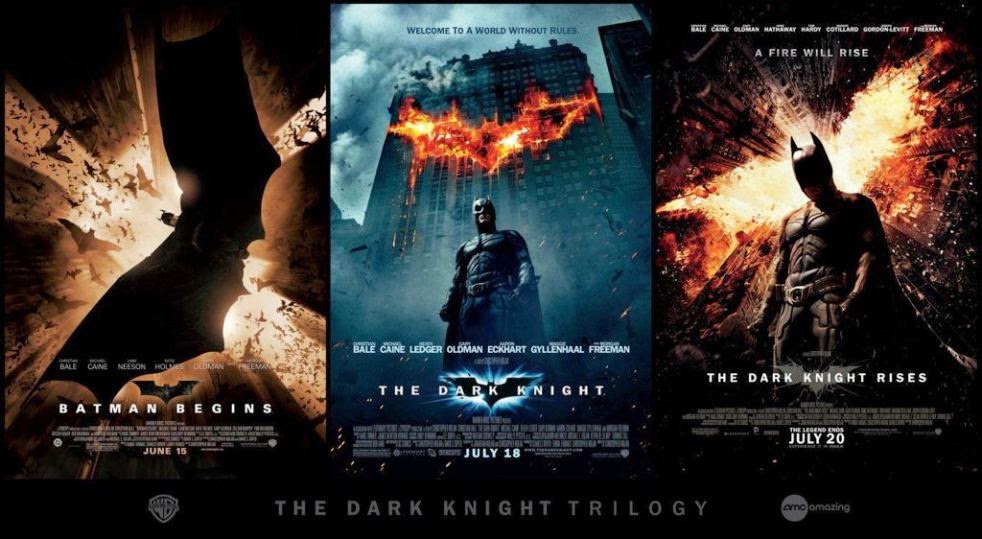
Hopes were high for Bat-fans around the world when it was announced that Christopher Nolan would be directing a new Batman film with Christian Bale as The Dark Knight. They would not be disappointed because when Batman Begins was finally unleashed in 2005 it defied all expectations by being even better than the hype that surrounded it.
Original film poster for The Dark Knight Trilogy

Batman Begins – as the title suggests – is an origin story. It deals with Bruce Wayne’s transformation from scared kid (after watching his parents murdered in front of him) through his training with Raz Al Ghul and the League of Shadows (never mentioned in previous film incarnations) and finally to The Dark Knight of Gotham City. It’s steeped in authenticity and reverence to its original source – taking Bob Kane’s vigilante and rendering him big and bold onto our movie screens. It also benefitted from the fact that Batman doesn’t appear until at least an hour into the film, examining instead the psychology of a man driven firstly by revenge and eventually justice. Like Christopher Nolan’s previous films Batman Begins is complex and intelligent stuff, never once slipping into parody.

The cast is almost perfect. Christian Bale embodies the duality of Bruce Wayne/Batman; Liam Neeson nails Raz Al Ghul’s twisted sense of justice; Michael Caine captures the emotional heart of the film as Alfred Pennyworth, Bruce Wayne’s faithful butler and confidant; Cillian Murphy is suitably mad as the homicidal psychiatrist Jonathan Crane aka Scarecrow; Gary Oldman turns in another top notch performance as Batman’s only ally on the police force, Jim Gordon; and Morgan Freeman is as watchable as ever as Bruce Wayne’s loyal tech man, Lucious Fox. There’s great support from the likes of Tom Wilkinson, Rutger Hauer, Linus Roache and Ken Watanabe.  Only Katie Holmes fails to completely satisfy as Rachel Dawes – she looks much too young to be an Assistant District Attorney and this part was much better served by Maggie Gyllenhaal in The Dark Knight. But that’s just small beer in a production that is both intelligent and exciting, with a superb script by David S. Goyer and Nolan himself; beautiful cinematography by Wally Pfister; and an amazing score by the most innovative of all film composers, Hans Zimmer.

The fact that Christopher Nolan grounded the whole thing in reality made the adaptations of Marvel’s comic book characters seem silly in comparison. Nolan took Joel Schumacher’s one-dimensional character out of the depths of stupidity and turned him into a three-dimensional, believable, fully rounded and functional human being.

How on earth, then, could Nolan attain these dizzy heights again with a sequel? Sequels are usually notoriously disappointing (with the obvious exception of Francis Ford Coppola’s Godfather Part II), but somehow he not only managed to make a film as good as the original, he also massively improved on it.

The Dark Knight (2008) features a blisteringly brilliant performance by Heath Ledger. When you watch his portrayal of the mass murderer The Joker all memories of Jack Nicholson in the role evaporate into thin air.  Heath Ledger’s character study of a dangerously unhinged psychopath was as scary as Javier Bardem’s Anton Chigurh in the Coen Brothers’ almost literal adaptation of Cormac McCarthy’s No Country For Old Men the previous year. Like Chigurh, The Joker was a terrifying villain with no redeeming features – but unlike Chigurh, he was not interested in money. All he wanted to do was create chaos – a world without rules, as he put it.

Heath Ledger dominates the entire film and his performance was worthy of the posthumous Oscar he received – in fact it’s so powerful and intense that I have no doubt whatsoever that even if he had lived he would have received the Oscar. That’s not meant to take anything away from the rest of the performances. The main cast from Batman Begins are still as strong as ever and as mentioned earlier Maggie Gyllenhaal is an improvement on Katie Holmes. Particular mention, though, must go to Aaron Eckhart for his portrayal of the tragic District Attorney Harvey Dent. It’s a superb study of a character who becomes split down the middle, who makes his decisions on the flip of a coin. Early on in the film he’s talking to Bruce Wayne about the future of Batman and unwittingly prophesises both their futures by saying, “You either die a hero or live long enough to become the villain.”

The ending of The Dark Knight is not a happy one and you leave the cinema wondering where it could go next.

In The Dark Knight Rises (2012), the final (and for many people the best) part of the trilogy it explains where it does go next – and it’s completely unexpected. Batman has taken the blame for Harvey Dent’s death and is now a fugitive from justice. Bruce Wayne has taken this as an opportunity to stop donning the cape and cowl and has been in retirement as a recluse for seven years. Like Batman Begins you don’t see The Dark Knight until almost an hour into the film. There’s a thrilling start aboard a transport aircraft. Three new characters are introduced – Anne Hathaway is Selina Kyle who’s about as far removed from Michelle Pfieffer’s purring and illogical character in Batman Returns as Heath Ledger’s Joker was to Jack Nicholson. She is (like in the comics) a cat burglar, but the name Catwoman is never mentioned at all. Instead, she wears night vision googles which, when not in use and on top of her head, look like cat’s ears. There’s the great British actor Tom Hardy as the ruthless and terrifying mercenary Bane, Batman and Bruce Wayne’s nemesis who, apart from one short scene, spends the entire film behind a mask. It’s difficult for any actor to convey emotion behind a mask and only two other actors, as far as I’m aware have achieved this – Hugo Weaving as V in the Wachowski Bothers 2005 excellent adaptation of Alan Moore’s V for Vendetta and Karl Urban as John Wagner and Carlos Esquerra’s creation, Judge Dredd, in the awesome Dredd. But Tom Hardy pulls it off with ease. Finally, there’s rising star and one of Christopher Nolan’s regulars, Joseph Gordon Levitt who gives a quietly understated performance as the ordinary cop Officer Blake, who along with Jim Gordon (probably Gary Oldman’s best performance in the trilogy) have to save Gotham City from destruction.

There are a number of twists in the tail of this (almost) three hour movie, which I won’t go into in case you haven’t seen it. On its release, however, there were a number of people who were disappointed with this final part of the trilogy. But it had been four years between The Dark Knight and The Dark Knight Rises and people have short memories. It’s difficult, I admit, to watch this third outing for the Caped Crusader without thinking of Heath Ledger’s Joker, but seeing the three films as a whole – back-to-back – it’s a spectacularly brilliant experience and all three together tell one big story that has a satisfying and logical conclusion.

For me – as a lifelong fan of Batman in both comic, TV and movie form – it’s the best trilogy ever made. I know I may sound biased here, but I really don’t care. I think it’s better than Lord of the Rings which seemed to go on forever in its final hour, certainly better than Star Wars, and better than The Godfather, where the final part of the trilogy was a massive disappointment. 

As a whole The Dark Knight Trilogy is a spectacular achievement. And if you don’t agree with me, then you’re wrong.

Saturday, 13 September 2014

MONTY PYTHON'S LIFE OF BRIAN (1979)


My mum never understood Monty Python’s Flying Circus when it was on television. She would let me stay up to watch it when my stepfather was on nights and would observe me with puzzlement as I laughed uncontrollably while she watched, stony-faced, unable to grasp what the hell I was laughing at. She didn’t find it funny at all and she was one of many parents throughout the country who didn’t get it. I found this odd because she was of the generation who listened to Harry Secombe, Peter Sellers and the great Spike Milligan in The Goon Show. But then again, she didn’t find that funny either. My mum’s idea of a good comedy was the banal Terry and June Show and which, along with her preference for Cliff Richard over Elvis Presley, only served to reinforce my view that my mother had absolutely no taste whatsoever.

In 1975 I was in the Royal Air Force stationed at RAF Brüggen in West Germany and the week she came out to stay with me just happened to coincide with the week that Monty Python and the Holy Grail was showing at the station cinema. The films that were shown there were only on for a week and then they disappeared and so it was with reluctance that I informed her that she would be accompanying me to the cinema to see it. The Astra cinema was packed full of Monty Python fans who could quote entire sketches from the TV programme. My mum, unsurprisingly, thought it was rubbish and while everyone around her were falling off their seats in laughter she sat blank-faced at what must have been the longest 85 minutes of her life.

In 1979 I was living in the fairly cosmopolitan town of Stafford – it had every type of restaurant you could think of; pubs within easy walking distance of other pubs; all the shops you could possibly wish for; a nightclub and a cinema that showed all the up-to-date films. There was one film, however, that it wouldn’t show. The cinema in Stafford was, like many of the cinemas around the country, banned from showing it by the County Council because it was considered to be the most blasphemous film ever made. They didn’t want to run the risk of upsetting the church and having hordes of rabid, lunatic protesters lining the streets. So, instead of watching the film in Stafford I travelled with a group of friends to Wolverhampton, where they didn’t bow to the ridiculous pressure inflicted by the church and its misguided, empty-headed followers.

The film I’m referring to is, of course, Monty Python’s Life of Brian. As we were queuing to buy our tickets we were assailed by groups of brain-washed idiots handing out leaflets explaining why we shouldn’t see the film. These morons had spent all their days consumed with so much hatred for this film that they hadn’t left themselves enough time to actually see it and to make up their own minds whether or not it was blasphemous. Free will – the ability to decide for ourselves whether we like something or not – is an amazing thing that we humans are possessed with, but it’s also something that the church at the time considered to be extremely dangerous and was only too keen to take away from us.
The original film poster for Life of Brian
 

The problem was – the more they carped on about it the more people went to see it and instead of its audience being comprised of die-hard Monty Python fans it became a worldwide smash hit and one of the highest grossing films of that year.

The final nail in the coffin came on 9 November 1979 when the professional Christian and hypocrite, Malcom Muggeridge, and Mervyn Stockwood, the then Bishop of Southwark, appeared on the BBC chat show Friday Night, Saturday Morning with Michael Palin and John Cleese. The show was hosted by Tim Rice who had himself been accused of blasphemy for writing the lyrics to Jesus Christ Superstar ten years earlier. The aim of the show was to have a serious discussion about the film but Muggeridge and the Bishop had other ideas. Their plan was to ambush the two members of Monty Python but (unlike the A-Team) their plan didn’t come together and their raving and ignorant attack made them look like idiotic out-of-touch nutcases next to the calm, considered and intelligent approach taken by Palin and Cleese and almost overnight public opinion and sympathy swung over to the Pythons.

If Muggeridge and his purple-cassocked crony had actually bothered to see the entire film instead of missing the first fifteen minutes (because they were too busy finishing off their lunch together) they might have had a different opinion of it – but I doubt it. Like all religious nutters their eyes were blinkered to the fact that Life of Brian was not blasphemous at all. It’s abundantly clear right from the start that the film is not poking fun at Jesus but at the easily manipulated simpletons who will blindly follow any religion no matter how nonsensical it may be – and I think it was that, more than anything, which made Muggeridge and the Bishop and their crazed supporters so angry.

But is Life of Brian any good?

Well, yes it is. In fact it’s a work of comic genius and far and away the funniest British film ever made.

There’s a scene early on in the film that perfectly illustrates the madness of organised religion and the illogical and ridiculous thought processes behind it. It’s a scene involving a group of women pretending to be men by wearing false beards so they join in with the stoning of a man accused of blasphemy because he uttered the name of Jehovah. It’s an incredibly funny scene that carries a serious message about how religion controls people’s lives and it’s as relevant today as it was when the film was made thirty-five years ago. Religion has always been the province of men, where women are side-lined into becoming less important or even second-class citizens. This is the case in one of today’s major religions, although I won’t say which one in case I find myself on the wrong end of a fatwa.

But it’s not just religion that Life of Brian pokes fun at – imperialism is another of its satirical targets – and you can substitute Imperial Roman for British or American imperialism throughout the film. The pointlessness of terrorism is also included, especially when different factions all believing in the same aims achieve nothing because they’re all fighting amongst each other.

“Are you the Judean People’s Front?”
“Fuck off.”
“What?”
“We’re the People’s Front of Judea. Judean People’s Front!”
“Wankers!”

Life of Brian is so funny all the way through that it’s hard to single out it’s anarchic set-pieces – but there’s the stoning (“She did it! She di – he did it! He did it!”); Jesus’ Sermon on the Mount where the spectators at the back are mishearing what he’s saying (“Blessed are the cheese-makers”); the mob proclaiming that Brian is the Messiah (“I’m not the Messiah!” “Yes you are and I should know – I’ve followed a few!”); Brian’s Mum (“He’s not the Messiah – he’s a very naughty boy!”); Pontious Pilate’s speech defect and his lisping friend Biggus Dickus and “What have the Romans ever done for us?” I could go on, but I won’t.

The film also deals with the nature of miracles. After Brian has stood on the foot of someone who has been in enforced silence for thirty years causing him to cry out in pain, the mob that has been following him pronounce it a miracle and when they complain of being hungry Brian points them to a juniper bush and they proclaim that as a miracle too.

In his 2008 documentary film Religulous Bill Maher visited a man who ran a shop selling religious relics. He was told by the shop-owner that he had witnessed several miracles, but when he was asked to describe one he said that he couldn’t think of one off-hand. “Well, they couldn’t have been that miraculous if you can’t remember any of them,” replied Maher. Eventually the shop-owner described a time when he was at a party and wanted a drink of water. He held an empty glass out of the window and prayed to God for rain and it did indeed rain.

“That’s wasn’t a miracle,” said Maher, “that was the weather.”

And when Maher asked the shop-owner if he believed in Santa Claus he was given a cursory, “Of course not,” as an answer. “Yeah, I know,” Maher said, “big fat guy in a red suit delivering presents to all the children in the world in one night – it’s ridiculous. But an invisible guy in the sky listening to everyone’s thoughts at the same time – you buy that, don’t you.”

Is that blasphemy? Of course it isn’t. In our 21st century world where we’re allowed to criticise everything why is religion and faith the one area where people get nervous? Why can’t we say what we want without fear of retribution?

Monty Python touched a nerve back in 1979, criticising the very people behind religious intolerance – the lunatics, the nutters and the maniacs. Would other film-makers be able to get away with it today with fundamentalism rising throughout the Christian and Muslim world? I’m hopeful but I doubt it and therefore Monty Python’s Life of Brian should be cherished because it gave organised religion a massive kick up the arse.

And really, if God, as Christians are always saying, made us in his image then surely he must have a sense of humour and the ability to laugh at himself.

Life of Brian made me laugh out loud when it was released– and it still does.

Saturday, 23 August 2014

THE THIRD MAN (1949)


On the 21st August 2014 my friends organised a party to celebrate the fact that I was still alive after sixty years of drunken debauchery. Part of this celebratory event was a screening of one of my favourite films, prior to the party getting underway. It was my friend (and bromance partner) Andy’s idea to choose The Third Man as he had discovered through nefarious means that it was my favourite British film. About thirty minutes into the screening Andy leaned over to me and asked, “Are you sure this is your favourite British film?”

“Yes,” I replied, “why?”

“It’s a bit slow isn’t it,” he said.

I gave him the kind of look you give to someone who has just said something momentously stupid and said, with as much derision as I could muster, “You fucking philistine. This is not an action movie. If you want an action movie go home and watch The Expendables 3 or Terminator 2. This is The Third Man – it’s written by Graham Greene for God’s sake!”

Obviously devastated by his inability to recognise one of cinema’s most brilliant works of art, he bowed his head in shame and succumbed quietly to my opinionated, but persuasively subtle argument.

The first time I saw The Third Man was on television and it knocked me sideways with its imaginative camera angles, its lighting that was reminiscent of the German expressionist films of the twenties and thirties, its use of the zither as the sole instrument on the soundtrack, and its flawed but sympathetic main characters, and its unexpected downbeat ending. Anyone who had ever read the novels of the great Graham Greene could tell immediately that they were in Greeneland. The main character, Holly Martins (Joseph Cotton), is a down-at-heel hack writer of western dime novels, visiting a war-ravaged Vienna to look for his old friend Harry Lime (Orson Welles). When he gets there he discovers that Harry Lime is dead, run over by his own car, and buried. But, as in all of Greene’s work, not everything is as it seems.
The original film poster for The Third Man
 
Joseph Cotton and Orson Welles had worked in partnership before on Citizen Kane (1941) and The Magnificent Ambersons (1942) – and it shows in every frame when they share screen time together. Welles’ spectacular but controversial debut film, Citizen Kane, caused a sensation on its initial release and has continued to fascinate and astound movie buffs ever since. His brilliant second feature, The Magnificent Ambersons, charts the decline of a once wealthy family destroyed by industrialisation – it’s a film that would have been even better if RKO executives hadn’t decided to cut out forty minutes (and burn the only negatives) while Welles was out of the country filming Journey into Fear (1942) because they thought it was too depressing. By the time he came to The Third Man in 1949 he was short of money for his next project and instead of taking a share in the profits he accepted a straight one-off fee, a decision he later regretted as it turned out to be the highest grossing British film of that year. He would have a chequered career after that, but one where he directed and starred in two more genuine classics, playing the bloated, corrupt cop Hank Quinlan in the superb Touch of Evil (1958) and Shakespeare’s rambunctious Falstaff in Chimes at Midnight (1966).

Although never becoming the A-list star he should have become, Joseph Cotton nevertheless carved out a successful career for himself playing a host of differing and sometimes difficult roles – the suave serial killer in Hitchcock’s excellent Shadow of a Doubt (1942), the surgeon Dr Vasalius in Robert Fuest’s delicious black comedy The Abominable Dr Phibes (1971), the Secretary of State in Robert Aldrich’s brilliant thriller Twilight’s Last Gleaming (1977), and the Reverend Doctor in Michael Cimino’s disastrous but highly underrated western Heaven’s Gate (1980).

But it’s as Holly Martins that I will always remember him. His character is not the traditional hero and he’s out of his depth in almost everything he gets himself involved in – from his naïve and bumbling attempts to investigate Harry Lime’s death in a bombed out Vienna that’s divided by four major powers to his attempt to talk about writing cheap westerns to an audience of intellectuals – and he breathes life into his character in every situation, particularly in the three short scenes he shares with his friend Orson Welles.

It’s over an hour into the film before Welles makes what surely must be the greatest and most dramatic entrance of any actor in any film ever, and it’s one that never fails to make the hairs on the back of my neck stand on end whenever I see it. There’s also the brilliant final section in Vienna’s cavernous sewers and in between there’s the now-famous Ferris Wheel scene, where Harry Lime, in trying to justify selling his stolen, diluted and now poisonous penicillin on the black market, tells Martins, “In Italy under the Borgias they had warfare, terror, murder and bloodshed, but they produced Michelangelo, Leonardo DaVinci and the Renaissance. In Switzerland they had brotherly love – they had five hundred years of democracy and peace, and what did that produce? The cuckoo clock.”

Welles totally dominates the remaining forty minutes of the film – from the moment we first see him in a dark doorway, his face briefly illuminated by the light from an apartment window above, giving his old friend Holly Martins the kind of smile that only he could give, to his final flight from justice under the streets of Vienna. His brief but perfect performance of a man with no scruples and even less remorse for the lives of the children his evil trade has destroyed is nothing short of astonishing.

The supporting cast are uniformly superb – Italian actress Alida Valli, is Harry Lime’s loyal girlfriend, desperately trying to keep herself from being claimed by the Russians; the great Trevor Howard is the efficient by-the-book British intelligence officer Major Calloway; Bernard Lee (thirteen years away from being James Bond’s M in Dr No) is his western loving sergeant; and Wilfred Hyde-White (giving another great performance as Wilfred Hyde-White) is the dithering cultural attaché who mistakenly thinks that Martins is a ‘proper’ author.

Although Orson Welles received top billing, the real stars of this film are the director Carol Reed (Oliver Reed’s uncle) and photographer Robert Krasker. Between them they produced a masterpiece of noir cinema – odd camera angles were used to give the audience a sense of disorientation, back lighting was used to produce lengthened shadows and dark, forbidding passageways, giving the whole thing a sense of unrelenting menace. It was shot in Vienna – this was the real bombed-out Vienna and not just a set built on a studio lot, and close-ups of the faces of actual inhabitants were used to reflect the desperation of the people living there. And Carol Reed’s choice of using Anton Karas and his zither for the score was inspired.

Then there was the great novelist Graham Greene and his excellent screenplay. Greene was one of the 20th century’s most highly regarded novelists – he called his books ‘entertainments’ and no two were the same. Fans of his novels were never entirely sure what they were going to get next from him, but they knew one thing – whatever it was it going to be it would be original and surprising. His body of work – Brighton Rock (1938), The Ministry of Fear (1943), Our Man in Havana (1958), The Comedians (1966) and Doctor Fischer of Geneva (1980), to name just five – testifies to that.

The final scene of the film is different to that of Greene’s original novella. Carol Reed disliked what he felt was an artificially happy ending and changed it to something more downbeat and believable. Greene argued his corner but lost out to the pressure put on him by Reed and his producer, David O. Selznick. But upon seeing the final result Greene said, “One of the few major disputes between Carol Reed and myself concerned the ending, and he has been proved triumphantly right.”

He was absolutely correct, not just about the ending but of the film as a whole. Time magazine described it as “being crammed with . . . ingenious twists and turns of plot, subtle detail, full-bodied bit characters, atmospheric backgrounds that become an intrinsic part of the story, a deft comingling of the sinister with the ludicrous, the casual with the bizarre.”

I couldn’t agree more. It’s why this is my favourite British movie of all time.

Now, Andy, I know you are an artistic soul and so I therefore urge you to stop watching White House Down immediately and re-watch The Third Man instead – hopefully you will at last be able to recognise it for the classic that it is, thus making your life both intellectually and artistically fulfilled.

You know I’m right.

Thursday, 21 August 2014

BULLITT (1968)


In 1971 Clint Eastwood as Lt Dirty Harry Callaghan walked the mean streets of San Francisco, asking perps whether he had fired six shots or only five from his Magnum .45 (the most powerful handgun in the world) because he had clean forgot. Sergio Leone’s Dollars Trilogy had made Eastwood a star but it was Don Siegel’s Dirty Harry that blasted him off into the stratosphere and made him the superstar that he is today. It’s now almost unthinkable that the original choice for that role was Frank Sinatra, but Eastwood was lucky because Sinatra had sustained an injury and was unable accept the role. The studio wasn’t sure about Clint Eastwood – they thought he wasn’t a big enough star to attract audiences into cinemas, even with his spaghetti westerns behind him. How wrong they were because as it turned out Clint will be forever remembered as Dirty Harry, the maverick cop who cleaned up the streets of San Francisco.

But three years earlier a film featuring a much grittier and more believable cop provided the blueprint for Dirty Harry, and that film was Bullitt. More than anything though, Bullitt demonstrated how a good thriller should be made and its authenticity and naturalistic dialogue was the catalyst for many of the cop films that were to follow, particularly William Friedkin’s superb The French Connection (1971).

What neither Dirty Harry nor The French Connection had though (and this is what sets Bullitt apart from them and from every other cop thriller that followed) was that it had Steve McQueen, the coolest man on the planet, in the leading role.

Bullitt contains Steve McQueen’s finest ever performance – yes, even better than that of Hilts, the Cooler King, in John Sturges’ fantastic ensemble piece The Great Escape (1963), for which he is best remembered. Bullitt, however, is McQueen’s film all the way – his character totally dominates it, even in the brief moments when he’s not on screen. It’s a wonder though that he ever became a star after his B-movie debut in the The Blob (1958), after which he had to content himself with small roles in minor films until 1960 when he hit the big time after being cast as Vin Tanner, in the remake of Akira Kurasawa’s Seven Samurai (1954) – The Magnificent Seven, also directed by Sturges. The cast was great – alongside Brynner and McQueen were Eli Wallach, James Coburn, Charles Bronson, Robert Vaughn, Brad Dexter and the young German actor Horst Buchholtz. During the filming Yul Brynner complained that McQueen was always doing something – with his hands, his eyes and with whatever he happened to be holding. What McQueen effectively did was completely upstage the veteran actor and steal the entire ensemble piece from every other actor on screen (with the possible exception of the great Eli Wallach) – and it was that performance that made him a star. When I saw the film in 1966 with my granddad at the Tivoli in Blackpool (it was on a double bill with its inferior first sequel Return of the Seven) all I could talk about on the way home was Steve McQueen.
The original film poster of Bullitt
 
By the time he made Bullitt in 1968 he was the coolest man on earth – women wanted him and men wanted to be him. Since The Great Escape and The Magnificent Seven he had played opposite the formidable Edward G. Robinson in The Cincinatti Kid (1965) and the sexy cool of Faye Dunaway in The Thomas Crown Affair (1968).

But Bullitt was different. Adapted from Robert L. Pike’s novel Mute Witness, the screenplay was by Alan Trustmore and Harry Kleiner, who turned in a tightly written and realistic script that used dialogue sparingly and didn’t treat audiences like idiots. There was no spoon-feeding here – audiences had to sit down and think about it and work it out for themselves. There are still people today who are confused by it but they are in the minority of morons who shouldn’t really be watching intelligent movies like this and should instead restrict themselves to brainless fodder like the pitiful Olympus Has Fallen and the woeful White House Down (both from 2013), where no brain activity is required for the entire length of either film.

Bullitt has a great opening title sequence and a score by Lalo Schifrin that –unlike most action films today – never intrudes or overwhelms what’s happening. The supporting cast is superb, with the marvellous Robert Vaughn playing an oily, self-serving politician (aren’t they all) and a radiant Jacqueline Bisset as Bullitt’s girlfriend, who’s unaware of the horrors he has to deal with on a daily basis. But it’s Don Gordon as Delgetti, Bullitt’s loyal detective sergeant who shines through the supporting cast, giving a performance of real depth and understanding of his character. And just to put the icing on the cake there’s Robert Duvall in the small role of a cab driver, just a few years away from his terrific performance as the Corleone family’s lawyer in Francis Ford Coppola’s The Godfather (1972) and his show-stopping, Oscar winning role as Colonel Kilgore – loving the smell of napalm in morning – in the brilliant Apocalypse Now (1979), also directed by Coppola.

There’s a European rather than Hollywood feel about Bullitt, which is not surprising as it was directed by Brit Peter Yates – his excellent 1972 movie The Friends of Eddie Coyle starring Robert Mitchum had a similar feel – and he was not afraid to have whole stretches with little or no dialogue. The final airport scene (which Michael Mann borrowed for the final scene of his 1985 crime movie Heat) is a good example – hardly a word is spoken and it works brilliantly.

But you can’t talk about Bullitt without mentioning the car chase. Steve McQueen had a lifelong love of motor racing, declaring once that, “Racing is life. Anything before or after is just waiting.” And it shows. McQueen drove the car himself for the entire scene and it’s a masterful, beefy, thunderous chase. Watch a car chase in today’s movies and you’ll notice that it’s comprised of cuts, most of them no longer than five seconds, to make it more exciting than what it is. In Bullitt there is none of that. There are no studio cuts – the entire scene was filmed on location – and it allows you to be in the driver’s seat with Bullitt as he races up and down the hills of San Francisco. You can actually feel your stomach hitting the floor as the car goes over the hills at speed, especially if you’re lucky enough to see it in a cinema or on the biggest television money can buy. 

As I said earlier though, this is Steve McQueen’s film all the way. He gives a deadpan, moody performance that is full of understatement and realism. He was never better before and would never be better again and it cemented his reputation as the top screen icon of his generation. His life, however, was cut tragically short – he died of cancer on 7 November 1980 after completing his final two films, The Hunter and Tom Horn.

I’ve watched all of his films, from his shaky start in stardom in The Blob through to his final two movies, rushed out because he knew that he was dying, and he was always interesting to watch. His untimely death robbed us of what he may have achieved had he been able live into old age, but for me at least, it will always be Bullitt that reminds me of what a great actor he was.

Saturday, 16 August 2014

2001: A SPACE ODYSSEY (1968)


Back in 1981 I was stationed at RAF Akrotiri in Cyprus and most of my evenings were spent working as an usher at the Station Cinema. It was a good way to while away the time for someone like me – I love the cinema and always have (I wouldn’t be writing this blog if I didn’t) and this job gave me the opportunity to see every film that was shown there for free. As an usher, one of my tasks was to maintain order, and this took the form of keeping the hordes of kids quiet while the film was in progress and to throw out any who were persistently disruptive. It was a thankless task – the adults complained to me about the noise the kids were making and the kids hated me for throwing them out. After a few weeks of this I came up with a brilliant plan – if the kids were making too much noise I would walk down the central aisle and as I did I would give a signal to the projectionist, who would halt the film. I would then stand at the front and in my most provocative voice I would shout, “Right, if there’s any more noise I’m going to throw two of you out – I don’t care which two, I’ll chose two of you at random. You have been warned!” The projectionist would then restart the film and the kids would remain silent, not quite sure whether I meant it or if I had just issued an empty threat. It usually did the trick, though. It’s true what they say – give someone a little power and they turn into Adolf Hitler.

The early Friday evening showing was reserved for the kids and the films that were screened were generally of the science-fiction adventure variety. These included Star Wars (1977), Superman (1978), Battlestar Galactica and Buck Rogers in the 25th Century (1979), The Empire Strikes Back, Flash Gordon and Superman II (1980). I didn’t mind the kids making a noise during these films because there were no adults in attendance. The adults usually kicked their kids out of their houses and sent them along to the cinema with some money to buy a ticket and enough sweets and sugary drinks to keep dentists in employment for years after. The adults would then be free to do whatever they did when the house was to themselves and the kids got to hoot and roar for ninety minutes or so without fear of me threatening to throw them out. It all went swimmingly until it was announced that Stanley Kubrick’s two-and-a-half hour seminal science-fiction masterpiece 2001: A Space Odyssey was going to be shown – in the early Friday evening slot.

I knew there were lots of adults on RAF Akrotiri who wanted see this film, mainly those who had been baffled by it when it was first released in 1968 and so I thought a warning would be appropriate, explaining that it was probably not the best film for children to see when they were pumped up with sweets and sugary drinks and expecting some daft action-packed science-fiction extravaganza. In light of this I produced an A3 notice that I stuck onto the film’s poster that was displayed outside the cinema. The notice read:

NOTICE TO PARENTS! THIS IS NOT A CHILDREN’S FILM! YOUR KIDS WILL BECOME BORED AND RESTLESS WITHIN THE FIRST FIFTEEN MINUTES AND WILL THEN BEGIN TO DISRUPT THE CONCENTRATION OF THE ADULTS IN THE CINEMA WHO HAVE COME TO ENJOY A TRULY TRANSCENDENTAL EXPERIENCE. IT WILL BE AT THIS POINT THAT I SHALL BE FORCED TO EJECT YOUR OFFSPRING FROM THE PREMISES. YOU SHOULD EXPECT YOUR CHILDREN TO BE HOME EARLY, THUS DISRUPTING YOUR PLANS FOR THIS EVENING. YOU HAVE BEEN WARNED!


I threw thirteen kids out within fifteen minutes of the film starting and the rest left of their own accord soon after.
Original poster for 2001: A Space Odyssey
I was fourteen years old when I first saw 2001: A Space Odyssey on its initial release in 1968 and I clearly remember walking out of the cinema feeling simultaneously amazed and baffled. There’s no dialogue for the first 24 minutes and again for the final 21 minutes. But I wasn’t the only one who stepped out of a cinema with a look of puzzlement after seeing this film. 241 people walked out during its premier, including film star Rock Hudson, who was reported saying as he left, “Can someone tell me what the hell this is all about?”

Well, what the hell is it all about? Cinema-goers who went to see 2001: A Space Odyssey expected a film about space travel and it is, to a certain extent, about exactly that. But this was a Stanley Kubrick film and anyone who has watched his films will know that on the surface you get what you pay for, but it’s underneath that surface that really counts, and underneath the surface of 2001 is a story about human evolution. And you’re really not supposed to understand it – you’re expected to make your own conclusions about what it’s all about. Arthur C. Clarke (who co-wrote the screenplay with Kubrick) adapted from his original short story The Sentinel, stated: “If you understand 2001 completely, we failed. We wanted to raise more questions than we answered.”

Its total length of 135 minutes is divided into four segments. The first segment is The Dawn of Man, and it follows a tribe of ape-men that are driven away from their watering hole by another, fiercer tribe. A black monolith appears when the tribe that have been evicted are sleeping and this triggers a leap in evolution and you see an ape-man putting two-and-two together as he discovers how to use a bone as the first tool. This tool, however, is used a weapon and the ape-men reclaim their watering hole, using the bone to kill the other tribe’s leader. At the end of the sequence the ape-man throws the bone up into the air at which point (using what’s known as a match-cut) the film jumps forward four million years, with the first weapon becoming the ultimate weapon – a nuclear device orbiting the earth.

The Dawn of Man is an incredibly realistic sequence and it seems astonishing now that it was totally disregarded by the judging panel for that year’s Oscars – the award for best make-up effects was given instead to John Chambers for his work on Planet of the Apes, which, despite being a brilliant film itself, still looked like it was populated by men (and women) wearing masks. Arthur C. Clarke often wondered afterwards whether 2001 had been ignored by the judges because they thought the ape-men were real.

The second part, TMA-1, starts with a fifteen minute dialogue-free sequence involving a shuttle docking with a half-completed space station, set to The Blue Danube Waltz by Johann Strauss. This has no relevance to the plot or character development and is there, it seems, just for the sake of creating a visually beautiful set piece – and mesmerisingly beautiful it surely is. 2001 is a unique film in that it forced audiences to watch it in a different way in which they watched other films – they had to sit back and relax and not care whether a scene had any relevance to the plot. They had, in effect, to watch it for the sake of watching it.

We then move to the Moon, where Dr Heywood Floyd (William Sylvester) and his team of scientists are inspecting a black monolith that has been buried under the surface for four million years. They have no idea of its origin or purpose and it’s known only as TMA-1 (Tycho Magnetic Anomaly One). During their inspection the monolith emits a high pitched radio signal and the film jumps forward 18 months.

Jupiter Mission, the third segment, follows the crew of the first manned mission to Jupiter – Dave Bowman (Keir Dullea), Frank Poole (Gary Lockwood) and three other scientists who have been in cryogenic sleep since before the mission commenced. There’s also a sentient computer system called HAL that controls the functionality of the ship. All is going well until HAL has a breakdown and kills four of the crew, leaving Bowman alone and isolated in deep space. HAL, a highly advanced artificial intelligence whose conflicting orders lead to his malfunction, is one of cinemas great tragic villains, and his resulting paranoia and insanity have devastating and far-reaching consequences for Dave Bowman.

The final part, Jupiter and Beyond the Infinite, is another dialogue-free segment. I’m not going to say anything about this in case whoever’s reading this hasn’t seen this film. I will say one thing though – when you watch it, it will blow your mind.

2001: A Space Odyssey is a magnificent film and to say that it was ahead of its time is an understatement and does no justice to its influence on the development of cinematic techniques and storytelling to come. Remember, this was made before CGI and even blue and green screens even existed. Its special effects would not come anywhere close to being matched for another nine years, until Steven Spielberg’s Close Encounters of the Third Kind (1977) came along, and even that didn’t have the totally immersive effect of 2001. Its influence has not been restricted to the science fiction genre either, and it’s leisurely pace and sparse dialogue can be seen in the films of Clint Eastwood, especially Hereafter (2010), and any film directed by the great Terrence Malick.

In this age of shoot ‘em up, slam-bang, fast-cutting, brainless action movies, it’s a pleasure to watch something that appeals to the intellect and takes its time to tell its story. And if I were to give advice to someone who was about to watch 2001 for the first time, it would be this: Be patient, because the rewards are manifold.

Friday, 8 August 2014

CASABLANCA (1942)


Before you begin reading this I must make one thing clear – I am a hopeless romantic and in order to put some kind of context to this piece I must first tell you the circumstances regarding the time when I met my gorgeous wife, Jackie.

When I first saw her, in December of 1995 she had just finished babysitting for my best friend Rebecca (or Becka as she liked to be called) in Winchester. I had never ever believed in love at first sight but here I was talking like a babbling idiot to this vision of beauty in front of me. Our conversation went something like this:

Jackie: I’m really into art.
Me: Duh-hur I really like art too.
Jackie: I like going to the cinema.
Me: Duh-hur I love films, me.

The conversation went like that for a good ten minutes and I must have sounded like a total moron to her. I knew what I wanted to say to her but I just couldn’t get the words out. On top of that I had just finished playing the villain in a local am-dram production of Aladdin and (in order to look the part) I’d grown a goatee beard and had my head shaved which made me look like a serial killer. Our first meeting reminded me of the time I went to see The Strawbs on their 25th Anniversary Tour a couple of years earlier at the Tower Arts Centre in Winchester. I’d always been a big fan of them and because the venue had a limited amount of seating I, along with the rest of the audience, had the opportunity to meet the band in the bar after the gig. Dave Cousins, the lead singer and guitarist and driving force behind them was a musician I particularly admired and I had rehearsed in my head the conversation I would have with him. It would be witty and intelligent, erudite and sophisticated. But when he actually shook my hand all I could get out of my stupid mouth was, “Duh-hur, I think you’re brilliant, me, I do. C-c-can I have your autograph?”

When I met up with Becka in the pub a week after my first encounter with the woman of my dreams I said to her that I really liked Jackie. Being the consummate matchmaker that she was, Becka informed me that Jackie had also liked me. I told her that I had just bought two tickets to see Casablanca, which was having a special showing at the multiplex in Basingstoke in January and wondered if Jackie might like come along with me. I knew that it was a long shot – I was thirteen years older than Jackie, but at least I’d shaved my goatee off and my hair was starting to grow back. Becka (and I am eternally grateful to her for this) had lied to Jackie, telling her that I was the most interesting person she knew and that I was really nice. She also lied to me when she informed me that Jackie was really interested in me and then she gave me her phone number. I only found out later that they hadn’t even communicated with each other because Jackie had been spending Christmas and New Year with her dad in the Lake District.

Being hopelessly in love with someone and not being able to contact them is torturous, but on 20 January 1996 she answered my call. Becka had already primed her to expect a call from me and I went round to see Jackie in her flat the following night. I’d already had several offers to accompany me to see Casablanca if Jackie turned me down, but as they were all from men, going to see probably the most romantic film of all time with another man seemed a little inappropriate. Fortunately Jackie agreed to come and see it with me and the rest – as they say – is history.

I’d already seen Casablanca about a hundred times and could quote most of the dialogue it contained.

The original poster for Casablanca 


So, what is it about this film (aside from the fact that I associate it with the first date with my wife) that I love so much?

Well, for a start, there’s the magnificent international cast. Humphrey Bogart, who was named the best actor of the 20th century, is Rick Blaine, an embittered, world weary cynic who ‘sticks his neck out for nobody’, but underneath that veneer of cynicism beats the heart of an idealist. It’s a role that fits him like a glove and when you watch the film it’s impossible to imagine anyone other than him playing that part. But he wasn’t the studio’s first choice – so try to imagine (if you can) how Casablanca would have turned out if the studio had got their way and cast Ronald Reagan instead of Bogart as Rick.

Then there’s the ravishing Swedish actress Ingrid Bergman, who I happen to think was the most stunningly beautiful woman that has ever graced the silver screen. She just radiates sex appeal without ever having to remove a single item of clothing – with the obvious exception of her coat. And she could act!

And then there’s the marvellous British actor Claude Rains as the Prefect of Police, Louis Renault – whose velvety voice and perfect diction disguised the fact that at home he spoke in a broad Cockney accent. He delivers a brilliant comic turn as the corrupt official with hidden depths. When Rick pulls a gun on him and says, “Remember, this gun is pointed right at your heart,” Louis replies, “That is my least vulnerable spot.”

There’s also the Austrian actor Paul Henried as Victor Lazlo, on the run from the Gestapo and desperately trying to get hold of Letters of Transit so he can escape unoccupied Casablanca with his wife and carry on the fight in America. The villain of the film, Major Heinrich Strasser of the SS, is played with charming menace by German actor Conrad Veidt, who had fled Nazi Germany in 1933 with his Jewish wife, where they would have certainly been murdered. In another of Claude Rains’ throw-away one liners Strasser says to Louis, “You give him (Rick) credit for too much cleverness. My impression was that he’s just another blundering American,” to which Louis replies, “We mustn’t underestimate blundering Americans. I was with them when they blundered into Berlin in 1918.”  

Add to this mix great supporting roles from Hungarian Peter Lorre (famous for playing the first on-screen serial killer in Fritz Lang’s M in 1931) as the weasly Ugarte and British actor Sidney Greenstreet as local black marketer Ferrari, both of whom had also played alongside Bogart in John Huston’s tremendous 1941 adaptation of Dashiell Hammett’s The Maltese Falcon.

And let’s not forget Dooley Wilson as Rick’s loyal piano player, Sam, and his rendition of As Time Goes By and that great Hungarian character actor SK Sakall as the loveable waiter Carl who says he has given Strasser the best table because “being German, he would have taken it anyway.”

Casablanca is a war film without any war in it, but it stills tells a story of courage, occupation and oppression. It’s peopled with disenchanted lovers and opportunists, patriots and isolationists. It’s imaginatively directed by Michael Curtiz and it is most definitely not the kind of standard, average, predictable love story that Hollywood had been churning out for years. But it’s the dialogue – delivered so skilfully and with such conviction – that makes it a glorious unexpected delight.

When Louis asks what in heaven’s name brought Rick to Casablanca, Rick replies “My health. I came to Casablanca for the waters.”

Louis: The waters? What waters? We’re in the middle of the desert.

Rick: I was misinformed.

Not only is Casablanca the most romantic film you’ll ever see, it is also one of the funniest. The script by Julius and Philip Epstein is shot through with sparkling wit and tremendous throw-away one-liners, all delivered by a cast at the very peak of their powers. It’s one of my top five films of all time and the only film that has ever come close to its delirious doomed romanticism is John Madden’s exquisite Shakespeare in Love (1998).

But it’s those one-liners that get me every time:

“Of all the gin joints, in all the towns, in all the world, she walks into mine.”

“Here’s looking at you, kid.”

“We’ll always have Paris.”

Unlike me, my wife is not a hopeless romantic - she’s a practical, level-headed artistic woman who knows what she wants. But for me (and I know she feels the same way too – even though she’ll probably never admit it) we’ll always have Casablanca.